Do Toilet Footstools Help You Poop?What Two Studies Measured
Bloating & DigestionArticleA footstool that lifts your knees on the toilet is cheap and widely recommended. In a study of 52 healthy volunteers who logged 1,119 bowel movements, using one cut straining and made people more likely to feel fully emptied. Neither study tested people with long-term constipation, so here is what the numbers show and how to run your own two-week test.
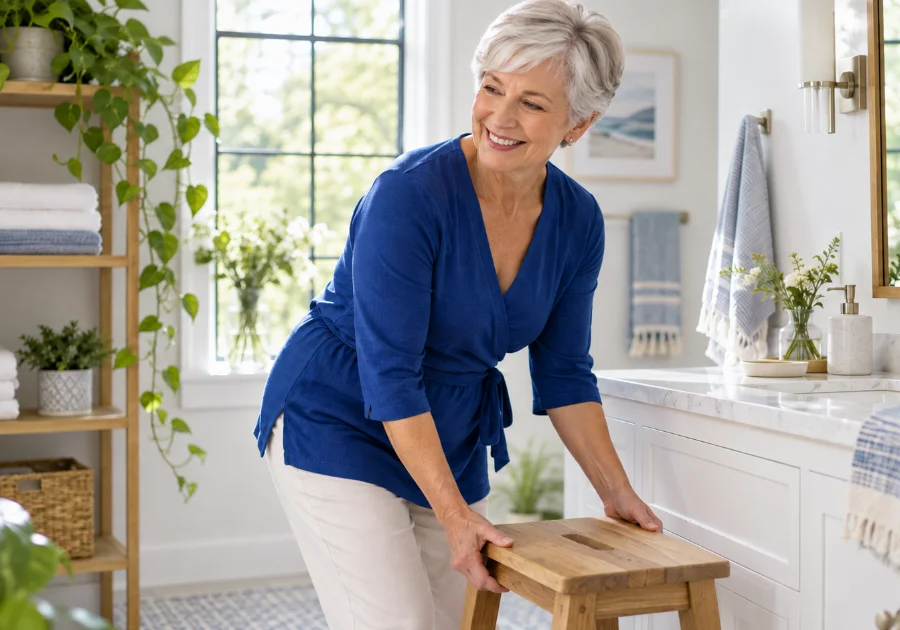
A small stool under your feet on the toilet raises your knees toward a squat. It’s standard advice: rest your feet on a low stool and, if you can, get your knees above your hips.1 Two studies have put numbers on it.
What they measured
| Study | Who | What changed | Result |
|---|---|---|---|
| Squatting, 2003 | 28 healthy volunteers aged 17 to 66, timing 6 bowel movements in each of 3 positions2 | Standard toilet seat, a lower seat, and squatting2 | Squatting cut both the time to feeling emptied and the effort in every volunteer2 |
| Footstool, 2019 | 52 healthy volunteers, average age 29, 40% women; 1,119 bowel movements logged3 | Two weeks without a footstool, then two weeks with one3 | Odds of feeling fully emptied 3.6 times higher; odds of straining down about three quarters; without the stool, bowel movements took about 25% longer3 |
What they can’t tell you
- Both studies used healthy volunteers with ordinary bowel habits, not people with long-term constipation.23
- Results were self-reported. People recorded their own times and effort.23
- The footstool study always came second, after two weeks without it, rather than in a random order.3
- The 2019 volunteers were young, averaging 29.3
So a footstool is a cheap, low-risk comfort step, not a proven treatment for constipation. Try our toilet posture guide to see the angles.
Run your own two weeks
- Two weeks feet flat, logging each bowel movement: the Bristol stool type, how long it took, whether you strained, and whether you felt finished.
- Two weeks feet up, changing nothing else.
- Compare time, straining and feeling emptied, the same things the 2019 study tracked.3
Give yourself time, and go when you feel the urge.1 For more, see why you’re constipated so often, kiwifruit, prunes and magnesium and pressing on the vagina to poop. See a clinician for blood in your poo, weight loss you can’t explain, or a sudden change in your bowel habits.1
Try: “I strain most mornings even with more fiber. I tried a footstool for two weeks and logged it. Should we look at my pelvic floor muscles?”
Bloated by Dinner covers this in Chapter 7, “Three and Three,” in a section called “Feet Up.” Its Belly Clock records the Bristol type, how long it took and whether you felt finished, so two weeks with your feet flat and two with them up can be compared line by line. See the book.
This article is for general educational purposes only and is not medical advice. It isn't a substitute for diagnosis or treatment from a qualified healthcare professional who knows your health history. See a clinician for blood in your poo, weight loss you can't explain, a sudden change in bowel habits, or constipation that doesn't improve. If you have hip or knee replacements or balance problems, ask before raising your feet on the toilet. Girl Playbook does not endorse any specific product, test, or provider.
Girl Playbook sells this book. It provides education and worksheets, not individualized medical care.
Sources
The research behind this article, in the order it’s cited. How we source our articles.
- NHS, 2023Constipation (opens in a new tab)abc
- Digestive Diseases and Sciences (abstract via PubMed), 2003Comparison of straining during defecation in three positions: results and implications for human health (opens in a new tab)abcde
- Journal of Clinical Gastroenterology (via PubMed Central), 2019Implementation of a Defecation Posture Modification Device: Impact on Bowel Movement Patterns in Healthy Subjects (opens in a new tab)abcdefgh
Spotted something out of date? Tell us and we’ll check it.


