Does Exercise Help Period Cramps?What the Cochrane Review Found
PeriodsArticle"Go for a walk" is the cramp advice nobody wants on day one. The best evidence says the timing matters: in 12 trials with 854 women, exercising about three times a week through the whole month cut period pain by about a quarter on a 100-point scale. Here is what the trials used, what they couldn't show for women over 25, and when worse cramps after 40 need a check.
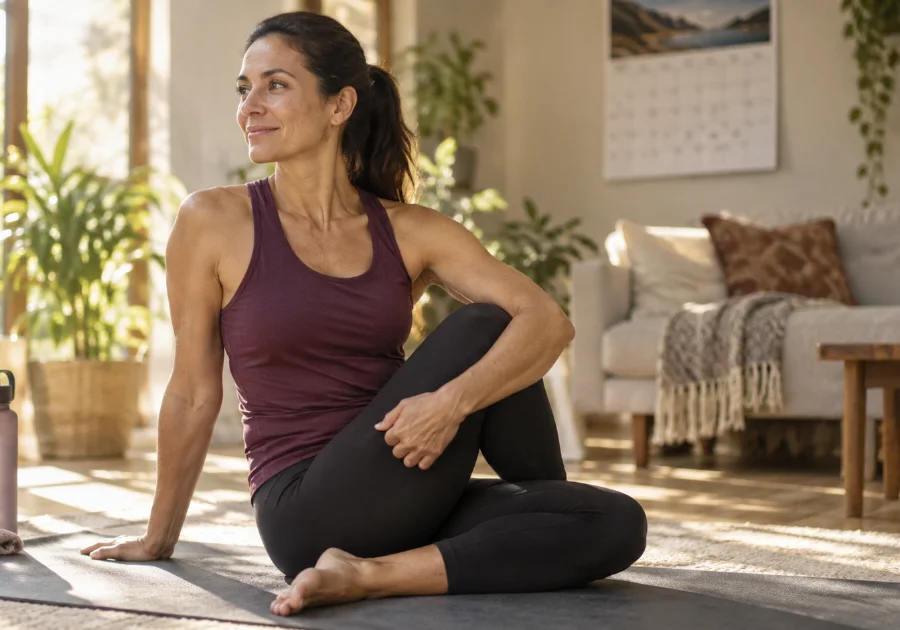
Exercise advice for cramps tends to arrive on the worst day, from someone who isn’t cramping. The trials point to a different time to move.
What the review found
A 2019 Cochrane review pooled 12 randomized trials with 854 women who had moderate to severe period pain with no underlying condition.1
| What the trials showed | |
|---|---|
| Pain | Down about 25 points on a 100-point scale compared with no exercise, a change the authors called likely to matter clinically1 |
| How much | About 45 to 60 minutes, 3 or more times a week, at any intensity1 |
| What kind | Stretching, core work and yoga, or Zumba and aerobics; no trials tested weight training1 |
| When | Throughout the month. Some trials asked women not to exercise during their periods1 |
So the helpful window is the two or three weeks when you feel fine. On a cramp day, a heat pad is still a standard self-help step, along with gentle walking, swimming, cycling or yoga if they feel good.2
What the review couldn’t show
- The evidence is low quality. Results varied a lot between trials, and women can’t be blinded to whether they’re exercising.1
- Age: the review says it’s unclear whether the benefit holds for women over 25.1
- Staying power: it’s unknown whether the effect lasts after the exercise stops.1
- Side effects weren’t well reported.1
The authors suggest exercise on its own or alongside anti-inflammatory painkillers such as ibuprofen.1 See ibuprofen and naproxen for heavy, painful periods and using a heating pad safely.
Cramps that change after 40
The review only included cramps without an underlying cause.1 If your cramps are new or worse than they used to be, the conditions that can cause painful periods include endometriosis, adenomyosis and fibroids.2 See a clinician if periods become more painful, heavier or irregular, if pain stops your usual activities, or if you have pain with sex, peeing or pooing.2 Pain that is severe and not eased by painkillers needs urgent advice.2 See why your cramps are so bad and adenomyosis.
Try: “My cramps are worse at 44 than they were at 34. I’ve been walking three times a week for two months and logging my pain. Could something like adenomyosis or fibroids be part of this?”
Period, Handled covers this in Chapter 7, “Cramps That Stop You,” in a section called “Moving, Even When You’d Rather Not.” Its Period Scorecard records a pain number each cycle; note what you did in the weeks between periods, and compare two or three cycles before and after you start. See the book.
This article is for general educational purposes only and is not medical advice. It isn't a substitute for diagnosis or treatment from a qualified healthcare professional who knows your health history. Get urgent help for period or pelvic pain that is severe or worse than usual and not eased by painkillers. See a clinician if periods become more painful, heavier or irregular, or if you have pain with sex, peeing or pooing. Check with your clinician before starting vigorous exercise if you have heart or lung disease. Girl Playbook does not endorse any specific product, test, or provider.
Girl Playbook sells this book. It provides education and worksheets, not individualized medical care.
Sources
The research behind this article, in the order it’s cited. How we source our articles.
- Cochrane Database of Systematic Reviews (via PubMed Central), 2019Exercise for dysmenorrhoea (opens in a new tab)abcdefghijk
- NHS, 2026Period pain (opens in a new tab)abcd
Spotted something out of date? Tell us and we’ll check it.


