Thinner Skin After Menopause: Collagen Loss and Whether HRT Helps
Menopause & HormonesArticleSkin loses collagen fastest in the first years after menopause, about 30% in five years by one widely cited estimate. Older biopsy studies found more collagen in women given hormone implants. A four-year randomized trial of modern hormone therapy found no difference in facial wrinkles or firmness. Here is what changes, what the trials show, and what helps thin, dry skin.
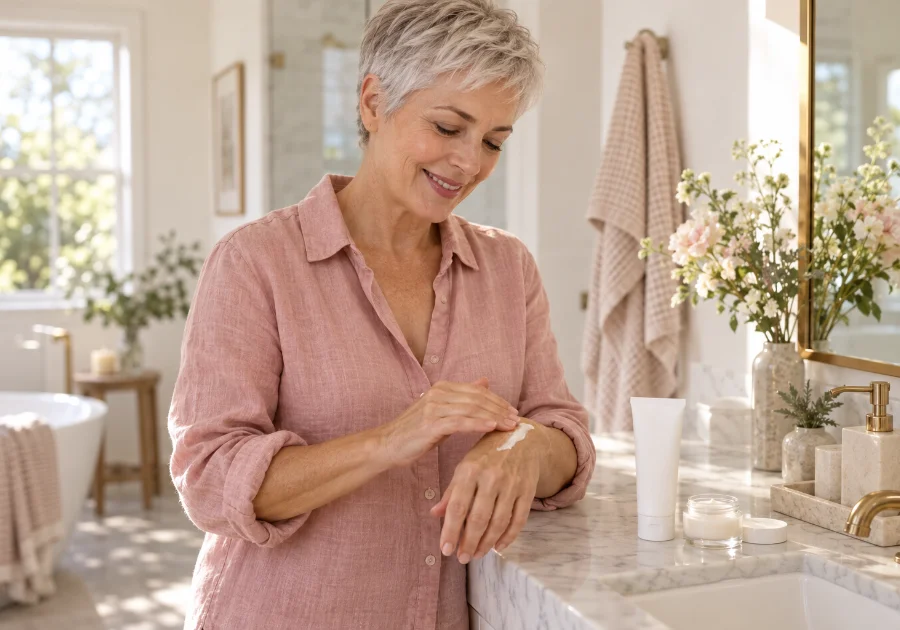
Skin after menopause can feel drier, look thinner and bruise more easily.1 Here is what the research shows about why, and what changes it.
What happens to collagen
Collagen gives skin its firmness and thickness. US dermatologists cite studies showing skin loses about 30% of its collagen in the first five years of menopause, then about 2% a year for the next 20.1
Studies from the 1980s pointed to hormones:
- Biopsies from 55 postmenopausal women found about 48% more collagen in those who’d had estrogen and testosterone implants for 2 to 10 years.2
- In women without hormones, collagen fell with years since menopause, not with age itself. Women given implants had thicker skin.3
Those studies compared treated and untreated women rather than assigning treatment at random, used implants that included testosterone, and measured tissue, not how a face looked.2
Does modern hormone therapy change wrinkles?
The best test is a randomized trial, the KEEPS skin study:4
| KEEPS skin study | |
|---|---|
| Who | Women aged 42 to 58, within 3 years of their last period4 |
| Treatment | Low-dose estrogen pill, estrogen patch with progesterone, or placebo, for 4 years4 |
| Measured | Wrinkles at 11 spots on the face and neck, and firmness of the forehead and cheek, every year4 |
| Result | No difference in wrinkles or firmness between hormones and placebo4 |
The biggest predictor of skin aging in those four years was race and ethnicity, not hormones.4 Hormone therapy is used for symptoms like hot flashes, not for skin appearance; see is hormone therapy safe?
What helps
- Sunscreen every day, SPF 30 or higher, on face, neck and hands. It can’t thicken skin but can prevent further thinning.1
- A mild cleanser instead of soap, which can be too drying for mature skin.1
- Moisturizer after bathing and whenever skin feels dry; hyaluronic acid or glycerin can help.1
- Ask about a retinoid cream or laser if thinning or lines bother you.1 See prescription tretinoin.
Collagen supplements have weak independent evidence; see do collagen supplements work? For easy bruising and tears, see purple bruises on the forearms and skin tears and thin skin.
Try: “My skin has become thin and dry since menopause, and it bruises easily. What can I do for it, and is anything here a reason to look closer?”
My Body Changed. Now What? covers this in Chapter 9, “Desire, Skin and Hair,” in a section called “Skin After Estrogen.” Its Change Map separates itching, cracking, a new rash and a cosmetic worry, so you can tell a clinician which one you’re bringing. See the book.
This article is for general educational purposes only and is not medical advice. It isn't a substitute for diagnosis or treatment from a qualified healthcare professional who knows your health history. Hormone therapy isn't prescribed for skin appearance alone; discuss its benefits and risks for your symptoms with a clinician. See a clinician for itching that disturbs sleep, a new rash, skin that tears or bruises with little or no injury, or a spot that is new or changing. Girl Playbook does not endorse any specific product, test, or provider.
Girl Playbook sells this book. It provides education and worksheets, not individualized medical care.
Sources
The research behind this article, in the order it’s cited. How we source our articles.
- American Academy of Dermatology Association, 2025Caring for your skin in menopause (opens in a new tab)abcdef
- BMJ (via PubMed Central), 1983Sex hormones and skin collagen content in postmenopausal women (opens in a new tab)ab
- British Journal of Obstetrics and Gynaecology (abstract via PubMed), 1985Long-term effects of the menopause and sex hormones on skin thickness (opens in a new tab)↩
- Fertility and Sterility (abstract via PubMed), 2016Effects of hormones on skin wrinkles and rigidity vary by race/ethnicity: four-year follow-up from the ancillary skin study of the Kronos Early Estrogen Prevention Study (opens in a new tab)abcdef
Spotted something out of date? Tell us and we’ll check it.