What Are Age Spots, and Can I Get Rid of Them?
SkinArticleWhat those flat brown spots on your hands and face are, why sun exposure from decades ago shows up now, which spots need a dermatologist, and what lightening options exist.
In this article
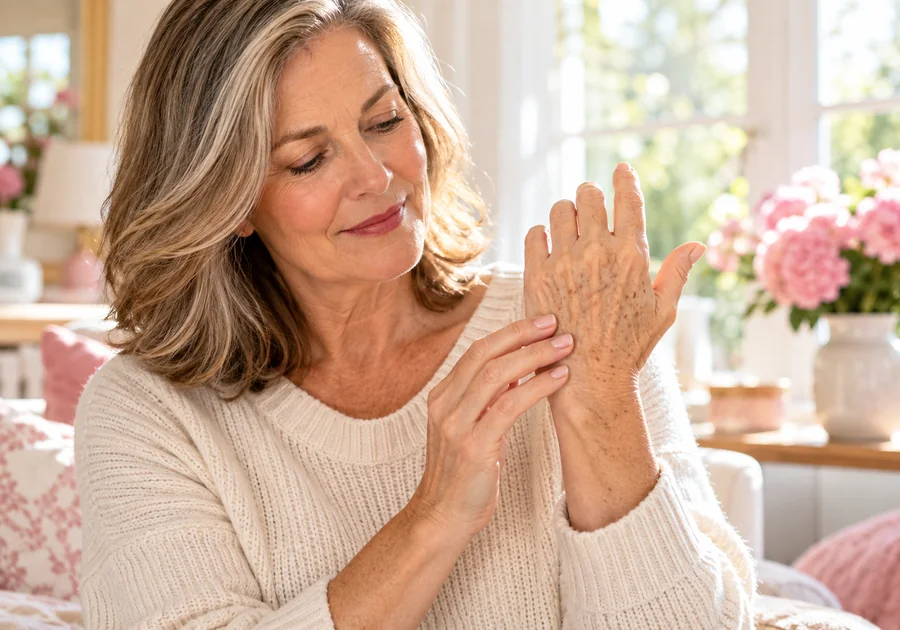
You were reaching for the steering wheel when you saw it. A flat brown patch on the back of your hand that wasn’t there last year, or maybe was and you never looked. Then you checked the other hand. Two more. Your face in the visor mirror had a few as well.
What they are
Cleveland Clinic2 says they’re patches of darker skin on sun-exposed areas like the face, hands and arms, ranging from freckle-sized to about half an inch wide. MedlinePlus3 describes them as flat, light brown to black and painless. Harvard Health adds that they don’t itch.
They’re common after 50. Harvard Health puts the usual age at over 55, and says the sun exposure you got before the age of 20 is the major factor shaping how your skin looks later. So the spot on your hand is the summer of 1992, finally showing up.
Who gets them
Cleveland Clinic2 says they’re more common in adults over 50, particularly people with fair skin, a history of severe sunburn or lots of sun exposure, and that anyone can get them, including people who use tanning beds. MedlinePlus3 says they come from aging and from UV light, including sources other than the sun.
If you’ve noticed darker patches on your cheeks or forehead that look more like a mask, see dark patches on the face. That one has a different set of causes.
Do they need treatment?
No. Harvard Health says age spots do not need to be treated, and that if you want cosmetic therapy, a dermatologist can prescribe lightening medication or offer another type of treatment. MedlinePlus3 says they’re not dangerous but are permanent skin changes that affect how your skin looks.
The options on the lists:
- Lightening creams. MedlinePlus3 names bleaching lotions, typically hydroquinone, and Cleveland Clinic2 lists hydroquinone and retinoids.
- Freezing (cryotherapy). Named by MedlinePlus3 and Cleveland Clinic2.
- Laser or intense pulsed light. MedlinePlus3 lists both. Cleveland Clinic2 lists laser resurfacing.
- Chemical peels and dermabrasion. Both on Cleveland Clinic’s2 list.
Which one suits you depends on your skin and the spot, so this is a conversation for a dermatologist rather than a drugstore aisle. A new spot treated at home with a cream is also a spot no clinician has looked at.
The spots to take seriously
Age spots can look like skin cancer, and Cleveland Clinic2 says a dermatologist can tell by looking, or by doing a skin biopsy if cancer is a concern. Cleveland Clinic says to get checked right away if a spot bleeds, changes color, develops an irregular border or grows.
The American Academy of Dermatology (AAD)4 gives a checklist, the ABCDEs of melanoma:
- A, asymmetry. One half of the spot is unlike the other half.
- B, border. Irregular, scalloped or poorly defined edges.
- C, color. Shades of tan, brown or black, or areas of white, red or blue within one spot.
- D, diameter. Melanomas are usually greater than 6 millimeters, about the size of a pencil eraser, when diagnosed, but they can be smaller.
- E, evolving. The spot looks different from the rest or is changing in size, shape or color.
The AAD4 says to make an appointment with a board-certified dermatologist if you notice any new spots, spots that differ from others, or spots that are itching or bleeding.
Try this: a spot map
Take photos of your hands, face, shoulders and arms in good light, next to a ruler or a coin, and keep them in one album with the date.
In three months, compare. A spot that has changed in size, shape or color goes on the list for your dermatologist.
Check any spot that doesn’t look like its neighbors, even a small one. Ask your dermatologist about a full skin check if you’ve never had one.
Protecting the skin you have
Harvard Health suggests long sleeves, pants, a hat and sunscreen, and avoiding the sun from 10 a.m. to 3 p.m., when the rays are strongest. MedlinePlus3 recommends a broad-spectrum sunscreen with an SPF rating of at least 30, reapplied often, plus sunglasses. Cleveland Clinic2 says to avoid tanning beds entirely.
None of that erases the spots you have. It keeps new ones from showing up as quickly.
When to get checked
Book an appointment if any of these fit:
- A spot is new, or looks different from your other spots
- A spot is changing in size, shape or color
- A spot itches, bleeds or crusts
- A spot has an uneven border or more than one color
- You’ve had severe sunburns or used tanning beds and have never had a skin check
- You want a spot treated or removed
Brown spots on the backs of your hands are usually your sun history. The one that’s changing is the one that gets a photo and an appointment.
Any spot that is new, changing, itching or bleeding should be looked at by a dermatologist. Don't assume a dark spot is an age spot.
This article is for general educational purposes only and is not medical advice. It isn't a substitute for diagnosis or treatment from a qualified healthcare professional who knows your health history. Please don't ignore professional advice or delay getting care because of something you read here. If you think you may be having a medical emergency, call 911 or your local emergency number right away. Girl Playbook does not endorse any specific product, test, or provider.
Girl Playbook sells this book. It provides education and worksheets, not individualized medical care.
Sources
The research behind this article, in the order it’s cited. How we source our articles.
- Harvard Health PublishingAge spots (solar lentigo, liver spots) (opens in a new tab)↩
- Cleveland ClinicLiver Spots (Solar Lentigines) (opens in a new tab)abcdefgh
- MedlinePlusLiver spots (opens in a new tab)abcdefg
- American Academy of Dermatology (AAD)The ABCDEs of Melanoma (opens in a new tab)ab
Spotted something out of date? Tell us and we’ll check it.


