Why Is My Hair Shedding So Much?Postpartum and Stress Hair Loss
HairArticleWhy hair falls out in handfuls three months after childbirth, illness or a big stressor, how telogen effluvium differs from permanent hair loss, how long shedding lasts, and when six months is too long.
In this article
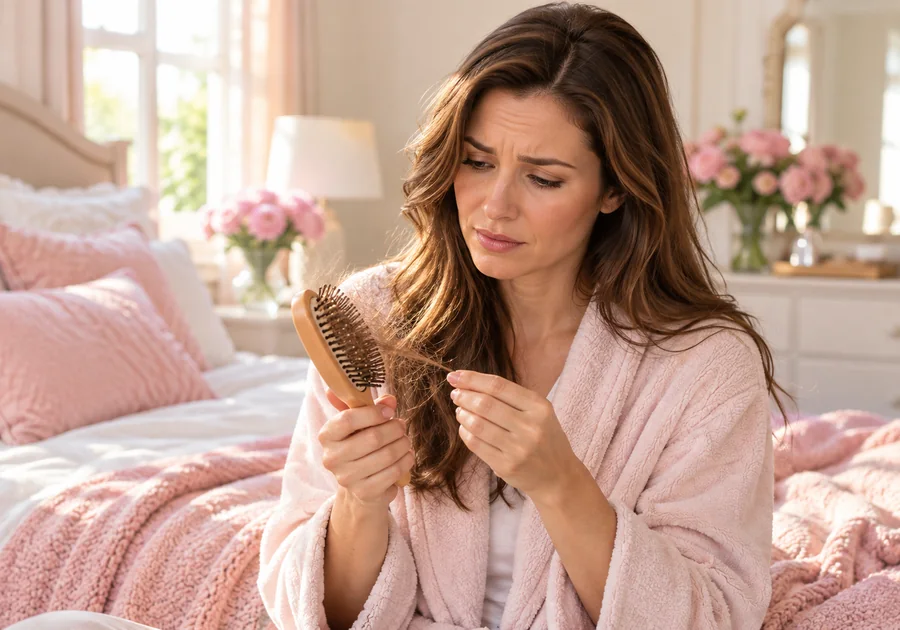
It’s the shower drain first, a dark clump you pick out with a tissue. Then it’s the hairbrush, the pillow, your sweater. You run your fingers through your hair and come away with a handful. Three months ago it was the baby. Or the flu with the fever. Or the worst quarter of your working life.
What’s happening
Cleveland Clinic3 says up to 70% of hair in the growing stage can prematurely enter the resting phase, which causes the loss. The BAD1 says normal shedding affects about 15% of the hair on your scalp, and that in telogen effluvium it rises to 30% or more, appearing around 3 months after the trigger.
Postpartum
Cleveland Clinic2 says changes in estrogen during and after pregnancy cause postpartum hair loss. High estrogen in pregnancy prevents typical shedding, and after delivery, levels drop and hairs enter the resting phase. It starts about three months after childbirth, lasts less than six months, and hair should regain its fullness by the baby’s first birthday. See thinning hair for other causes.
Other triggers
Cleveland Clinic3 lists high fever, childbirth, severe infections, psychological stress, major surgery, thyroid disorders, stopping birth control, restrictive diets and certain medicines. The BAD1 lists childbirth, severe trauma or illness, stressful events, surgery, marked weight loss and extreme dieting, and new medicines or stopping hormone treatments. It adds that in 1 in 3 people diagnosed, no cause can be found.
How long it lasts, and how it’s confirmed
The BAD1 says the shedding phase lasts between 3 and 6 months, and hair takes many months more to return to normal volume and thickness. Cleveland Clinic2 says hair typically regrows within three to six months once the stressor is addressed.
For diagnosis, Cleveland Clinic3 says a provider examines you and may do a pull test, gently pulling 40 to 60 hairs. Finding at least four to six hairs with white bulbs at the roots points to telogen effluvium. It adds that a healthy scalp, with no rash, itching or flaking, points that way too. The BAD1 says a blood test may be carried out to exclude other possible causes.
What you can do
Cleveland Clinic2 says there’s no specific medical treatment for postpartum hair loss, but gentle care helps: volumizing shampoos, lighter conditioners, gentle washing and combing, no tight hairstyles, lower heat, a shorter cut for a fuller look and a diet with enough nutrients for hair growth. See tight hairstyles and hair loss and vitamins and biotin.
Try this: a shedding timeline
Write down the date shedding started, and the events in the three months before: childbirth, fever, surgery, a new medicine, a big stressor or crash diet.
Count roughly how many hairs you see in the brush each day for a week, and take a photo of your part in the same light every two weeks.
If it’s still going at six months, bring the timeline in.
When to get checked
Cleveland Clinic2 says to talk with your provider if you continue to lose hair for more than six months, so they can look for causes like iron deficiency or thyroid disease. For telogen effluvium in general, it says to consult a provider as soon as you notice hair loss, especially if it causes added stress.
Book an appointment if any of these fit:
- Shedding has lasted more than six months
- You also have an itchy, flaky or rashy scalp
- You have other symptoms along with the shedding
- Your shedding is stressing you out
Shedding that arrives three months after the event is the delayed echo. For most women, it fades on a similar timetable.
Hair loss that continues beyond six months, or comes with itching, rash or other symptoms, deserves a clinician's evaluation.
This article is for general educational purposes only and is not medical advice. It isn't a substitute for diagnosis or treatment from a qualified healthcare professional who knows your health history. Please don't ignore professional advice or delay getting care because of something you read here. If you think you may be having a medical emergency, call 911 or your local emergency number right away. Girl Playbook does not endorse any specific product, test, or provider.
Girl Playbook sells this book. It provides education and worksheets, not individualized medical care.
Sources
The research behind this article, in the order it’s cited. How we source our articles.
- British Association of Dermatologists (BAD)Telogen effluvium (opens in a new tab)abcde
- Cleveland ClinicPostpartum Hair Loss: Causes, Treatment & What to Expect (opens in a new tab)abcde
- Cleveland ClinicTelogen Effluvium: Symptoms, Causes, Treatment & Regrowth (opens in a new tab)abc
Spotted something out of date? Tell us and we’ll check it.