RepHresh Pro-B oral vaginal probiotic supplement, US 30-capsule formula
RepHresh Pro-B Review for Recurring BV: Is the Daily Probiotic Worth Buying?
What its two strains have actually been studied for, why the seven-day claim needs context and how to decide whether a monthly bottle belongs in your care plan.
In this review
- What is RepHresh Pro-B, and do you swallow it?
- Which strains are in the current US formula?
- Does five billion CFU mean five billion through expiration?
- Can RepHresh Pro-B cure BV without antibiotics?
- What do the studies actually show?
- How long does it take to work? What about seven days?
- Can it treat yeast infections, UTIs or vaginal dryness?
- Is Pro-B better than a general probiotic or yogurt?
- Can you take it with antibiotics or other medicines?
- Can it cause stomach upset, and who should be cautious?
- How should you store it, and can you use an old bottle?
- What does a monthly bottle cost?
- Do you have to take it forever? Will stopping cause BV?
- When should you get checked instead of buying another bottle?
- Is RepHresh Pro-B worth buying for recurring BV?
You’ve treated the BV, felt better and then noticed the same unwelcome change again. A daily capsule sounds appealing when you’re tired of appointments, prescriptions and wondering what will happen after your next period.
RepHresh Pro-B is easy to find in that search. Its promise is vaginal balance, and the reviews can make a monthly bottle sound like the missing piece. But deciding whether to buy it takes more than counting enthusiastic comments.
Pro-B is worth discussing as an optional supplement with your clinician. It is a harder purchase to justify if you expect it to replace BV treatment or reliably prevent the next episode. The research on its strains includes encouraging results and important limits. Your buying decision should include both.
What is RepHresh Pro-B, and do you swallow it?
The US product is an oral dietary supplement. The manufacturer’s direction is one capsule per day, taken by mouth. “Vaginal probiotic” describes the intended area of health support; it doesn’t mean the capsule goes into your vagina. The company markets it for maintaining vaginal flora and identifies the current formula as vegan, non-GMO and gluten-free. 1
It is different from RepHresh Odor Eliminating Vaginal Gel, a separate product applied vaginally for pH-related odor support. A recommendation mentioning only “RepHresh” is incomplete: ask whether the person means Pro-B capsules or the gel. Don’t transfer one product’s application instructions to the other. 2
The distinction also matters when reading studies. A vaginal preparation and a swallowed capsule can contain similar-looking bacterial names without being interchangeable treatments.
Which strains are in the current US formula?
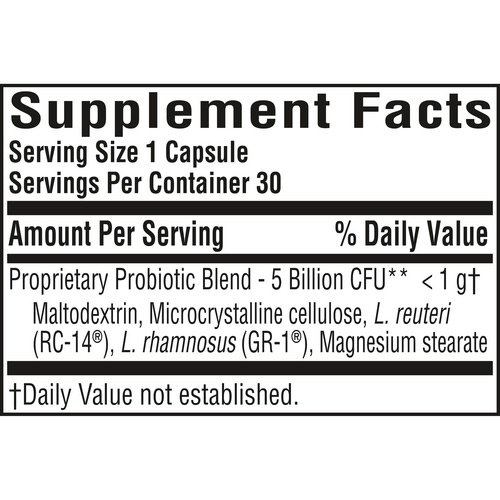
The manufacturer names Lactobacillus rhamnosus GR-1 and Lactobacillus reuteri RC-14. Its Supplement Facts image gives a one-capsule serving and a proprietary blend of five billion CFU. It doesn’t give a separate CFU amount for each strain. 1 3
The letters and numbers matter. A bottle listing the same species without GR-1 and RC-14 hasn’t established that it contains the same strains. Likewise, a longer list of species doesn’t automatically make another product better for the question you’re trying to answer.
The image also lists maltodextrin, microcrystalline cellulose and magnesium stearate within the blend. Check the complete ingredient and allergy information on your actual package; a front-of-box dietary claim isn’t a substitute for that panel. 3
You may see newer scientific names in research papers, including Lacticaseibacillus rhamnosus and Limosilactobacillus reuteri. Focus on the strain identifiers when comparing the paper with a label, rather than assuming a longer genus name means a different retail product.
Does five billion CFU mean five billion through expiration?
The brand qualifies its five-billion statement as at the time of manufacture. That is different from guaranteeing that count through the expiration date. 16
NIH explains that live counts can decline over a product’s lifespan and that labeling through the use-by date is preferable. It also emphasizes that benefits can depend on the particular strain and dose. A higher advertised count alone doesn’t settle which bottle is more useful. 9
That makes the label footnote a buying detail, rather than proof that the product is ineffective. Check the expiration date, package condition and storage directions. If you need a guaranteed end-of-shelf-life count to compare options, ask the manufacturer rather than treating the manufacture count as that guarantee.
Can RepHresh Pro-B cure BV without antibiotics?
Don’t buy it on that expectation.
The manufacturer’s supplement disclaimer says the product isn’t intended to diagnose, treat, cure or prevent disease. The CDC’s published BV treatment guideline also does not support probiotic products as an adjunctive or replacement therapy for BV. That clinical recommendation matters when deciding what belongs in a treatment plan. 1 4
This doesn’t mean nobody has studied these strains, or that every positive result should be dismissed. It means “clinically tested strains” and “a reliable substitute for prescribed BV care” are different claims. The trials below help explain the gap.
If a clinician recommends a supplement for your particular situation, ask what benefit they expect, whether it is optional and when you will reassess. Keep the prescribed treatment plan clear rather than swapping it for capsules because a shopper reported a fast result.
What do the studies actually show?
Some antibiotic-plus-probiotic studies were encouraging
A 2006 randomized, double-blind trial enrolled 125 premenopausal women with diagnosed BV in Nigeria. Everyone received oral metronidazole; participants also received GR-1/RC-14 or placebo twice daily for 30 days. Among the 106 who returned at day 30, the reported cure rate was 88% with antibiotic plus probiotics versus 40% with antibiotic plus placebo. This was combination care, not a trial of one daily Pro-B capsule instead of antibiotics. 5
A 2009 trial randomized 64 Brazilian women to tinidazole plus either two probiotic capsules or placebo capsules each morning for four weeks. The reported day-28 cure rates were 87.5% versus 50%. Again, both groups received an antibiotic, and the capsule schedule differed from the current retail direction. 6
Those findings explain why the strains attract interest. They don’t establish an 88% success rate for a shopper buying today’s bottle, or show that a month’s purchase prevents recurrence indefinitely.
A later adjunctive trial did not find a benefit
A 2021 Chinese trial enrolled 126 women and compared vaginal metronidazole with or without an oral GR-1/RC-14 probiotic drink. It was not blinded, and 99 participants attended the 30-day visit. Cure rates were about 58% with the added probiotic and 60% without it; the authors concluded that the added probiotic did not improve cure. Only 58 attended the 90-day visit, another limitation. This was a drink with a different dose and treatment setting, not a direct test of the current US capsule. 7
It would be unfair to treat that finding as proof Pro-B never helps anyone. It would be equally unhelpful to leave it out and present the earlier positive trials as a settled answer.
A larger capsule trial measured microbiota balance
A 2013 placebo-controlled trial included 544 women and used Lactogyn, another branded oral preparation containing these strains, for six weeks. Balanced vaginal microbiota were reported in 61.5% of the probiotic group versus 26.9% of the placebo group after the initial follow-up; the difference persisted at the later assessment. Those results are relevant to the strains, but aren’t a head-to-head comparison of current Pro-B with another store product or proof of lifelong recurrence prevention. 8
The practical conclusion is narrower than a glowing cure claim: there is research worth discussing, but the participants, products, doses, routes and outcomes differ. You cannot turn all of those studies into one reliable percentage for your next bottle.
How long does it take to work? What about seven days?
The manufacturer’s FAQ says its clinical studies show the product starts working within seven days. It also says Pro-B is not intended to treat yeast infections and advises medical consultation for itching or persistent odor. 2
“Starts working” isn’t a promise that a diagnosed infection clears in a week. A change in vaginal flora, a change in symptoms and confirmed treatment success are different outcomes. Nor does the claim establish that an unresolved problem should be given seven days before you seek care.
If you’re taking it with professional guidance, agree on what you are watching for. Fewer confirmed recurrences over time is a different question from feeling fresher tomorrow. Buying another box automatically doesn’t make that question clearer.
Can it treat yeast infections, UTIs or vaginal dryness?
These are different problems, even when the same shopping aisle sells products for all of them.
For yeast infections, CDC says there isn’t substantial evidence supporting probiotics as treatment. Persistent symptoms after an over-the-counter treatment, or symptoms returning within two months, warrant clinical evaluation and testing. A familiar itch doesn’t establish the diagnosis. 12
In its Target answers, RepHresh says Pro-B is not formulated to treat dryness and is not made specifically to treat or prevent UTIs. It also confirms that it doesn’t contain Lactobacillus crispatus. If a clinician recommended that organism or a particular preparation, this isn’t automatically the same recommendation. 10
Dryness may call for moisture support or another assessment. Burning with urination may need urine testing. Neither should become “my balance is off, so I’ll double the probiotic” without finding out what is happening.
Is Pro-B better than a general probiotic or yogurt?
It is more specifically marketed for vaginal support, and its named strains give you something concrete to compare with research. That is a useful distinction. It doesn’t establish that every digestive probiotic is useless or that Pro-B is the best choice for every buyer.
Compare the strain, intended outcome, dose, evidence and ongoing cost. A large CFU number and a long ingredient list can be less informative than a clearly identified strain studied for the issue you care about. Yogurt also isn’t a standardized replacement for a specific capsule regimen used in a trial.
You don’t need to turn ordinary food into medicine to decide whether a supplement is worth buying. And don’t insert yogurt or an oral capsule into your vagina in an attempt to recreate a study with a different preparation.
Can you take it with antibiotics or other medicines?
Ask your clinician or pharmacist about the actual prescription and the actual supplement. The brand’s FAQ recommends consulting a physician before combining Pro-B with other medicines. Pregnancy and breastfeeding also require professional advice before use. 2
The antibiotic trials are context for the evidence, not instructions to copy their doses at home. Your medication, route and treatment duration may differ. Don’t add more capsules to match a research schedule, and don’t shorten prescribed treatment because symptoms improve.
The retail precautions say to use only as directed and not exceed the suggested dosage. They also advise professional input when you have a medical condition, take medication, or are pregnant or nursing. 10
A simple question helps: “Do you want me to take this with my treatment, and if so, what schedule and review date do you recommend?” That gives you a plan you can follow without combining several strangers’ routines.
Can it cause stomach upset, and who should be cautious?
Probiotics are usually well tolerated by healthy people, but minor digestive effects such as gas can happen. NIH highlights greater concern in people who are severely ill or immunocompromised. Those general cautions aren’t evidence of a specific Pro-B injury rate; they are a reason to check suitability before adding a live-microorganism supplement. 9
New discomfort isn’t proof that the product is “working” or that you need a higher dose. Stop and ask for advice if you develop troublesome symptoms. People receiving immune-suppressing treatment or managing serious illness should make the decision with their care team.
The manufacturer now describes the US formula as vegan. Older customer comments describing gelatin or milk shouldn’t decide the ingredients in your current box. Read its complete label and contact the manufacturer if an allergy or dietary restriction makes an ingredient uncertain.
How should you store it, and can you use an old bottle?
Follow your package’s storage instructions. Probiotic products differ, so don’t assume every brand needs refrigeration or that adding refrigeration reverses previous heat exposure.
RepHresh’s brand answer on Target says the capsules are best used within 90 days of opening and before the expiration date, kept in their bottle with the cap closed. It places the printed date on the box and bottom of the bottle. The listing also warns against use when the plastic wrapper is missing or damaged. 10
If the date is unreadable or the package arrived damaged, resolve that with the retailer or manufacturer before use. A discount on questionable remaining stock is less useful than a bottle you can identify, store and finish as directed.
What does a monthly bottle cost?
On October 10, 2026, Target’s RepHresh listing showed $26.49 for 30 capsules. At the one-capsule daily direction, that is a 30-day supply costing about 88 cents per day, before taxes, delivery fees or discounts. 11
| Purchase period at that price | Capsules | Cost before extras |
|---|---|---|
| 30 days | 30 | $26.49 |
| 90 days | 90 | $79.47 |
| 180 days | 180 | $158.94 |
These are shopping calculations, not recommended treatment durations. Prices change, and a subscription’s first-box offer may differ from its renewal price. Check the latter before making the bottle a standing expense.
At that cost, the useful question is whether you and your clinician have a clear reason to continue. If the benefit remains uncertain, buying six months in advance removes flexibility without adding evidence.
Do you have to take it forever? Will stopping cause BV?
The daily direction describes how to use the supplement. It doesn’t establish that every person needs a lifelong purchase, or that stopping itself causes an infection.
The studies discussed here don’t settle that long-term question. Nor can a review saying odor returned after someone stopped establish the cause for everyone else. Symptoms can recur for several reasons, and a change in supplements may happen alongside other changes.
If symptoms return, seek evaluation rather than treating the return as proof you must buy Pro-B forever. CDC notes that persistent and recurrent BV are common and advises returning for evaluation when symptoms recur. There are clinician-managed options for repeated episodes; a supplement purchase shouldn’t replace that conversation. 4
When should you get checked instead of buying another bottle?
Odor, itching, burning and discharge can overlap across conditions. CDC explains that a history alone is insufficient to accurately diagnose vaginitis; examination and appropriate testing help identify the cause. A home pH result or an online symptom description doesn’t do the whole job. 13
Get assessed for a first episode, symptoms that are different from usual, unusual discharge or symptoms that aren’t improving. Pelvic pain or feeling feverish or shivery also needs medical attention. Irritation, skin conditions and hormone-related dryness are among other possible explanations, so not every change calls for more bacteria in a capsule. 15
Avoid douching. CDC notes it may increase BV relapse risk and has no supporting evidence as treatment or symptom relief. Buying a “balance” supplement doesn’t create a need for a cleaning routine inside the vagina. 4
Is RepHresh Pro-B worth buying for recurring BV?
Consider it if a clinician who knows your history thinks an optional trial fits your care, you understand the uncertain benefit and the monthly price is manageable. The named GR-1/RC-14 strains are a more useful reason to consider it than a generic promise to feel fresh.
Pause before buying if you’re trying to avoid evaluation for current symptoms, expect it to replace a prescription, want a dryness product, or assume five billion means guaranteed protection from future infections. It doesn’t need to become a permanent expense simply because recurrence is frustrating.
NCCIH advises against using probiotics as a reason to postpone care. Dietary supplements also don’t require FDA approval before marketing; that is different from approval as a medicine for a disease. 14
The decision can stay straightforward: know what you are treating, keep that care plan intact and agree on how you’ll judge whether the optional supplement is useful. For the wider picture, including odor, irritation and the questions to bring to an appointment, see Down There, Decoded.
Sources
- RepHresh / Church & Dwight: Current US Pro-B product, oral directions and supplement claims
- RepHresh / Church & Dwight: US FAQ: seven-day claim, yeast infections, medications and pregnancy
- RepHresh / Church & Dwight: Current manufacturer Supplement Facts image
- CDC: Bacterial vaginosis: probiotic guidance, recurrence and treatment
- Microbes and Infection, via PubMed: Anukam and colleagues, 2006: probiotics alongside metronidazole
- Canadian Journal of Microbiology, via PubMed: Martinez and colleagues, 2009: probiotic capsules alongside tinidazole
- Frontiers in Cellular and Infection Microbiology: Zhang and colleagues, 2021: randomized adjunctive-treatment study, full paper
- European Journal of Obstetrics & Gynecology and Reproductive Biology, via PubMed: Vujic and colleagues, 2013: Lactogyn capsules and vaginal microbiota
- NIH Office of Dietary Supplements: Probiotics: strain specificity, CFU labeling, storage and safety
- Target / RepHresh brand answers: 30-capsule US listing: precautions, ingredients and buyer questions
- Target: RepHresh product listing and 30-capsule price
- CDC: Vulvovaginal candidiasis: probiotics and persistent symptoms
- CDC: Vaginal symptoms: why history alone cannot establish the cause
- NIH National Center for Complementary and Integrative Health: Probiotics: regulation and not delaying care
- NHS: Vaginitis: assessment, other causes and avoiding douching
- RepHresh / Church & Dwight: Probiotic explainer: five billion at time of manufacture
This review provides general information, not individualized medical advice. Product specifications, prices, and seller policies can change; check the exact listing before ordering.
Girl Playbook sells the related book. It provides education, not individualized medical care.