Do Night Guards Stop Teeth Grinding?What the Reviews Found
Sleep & NighttimeArticleA night guard protects your teeth from grinding, but reviews of the trials haven't shown it stops the grinding itself, and no trial has measured whether it saves tooth wear. Here is what the Cochrane and UK reviews found, how Botox compares, and why your medicine list matters.
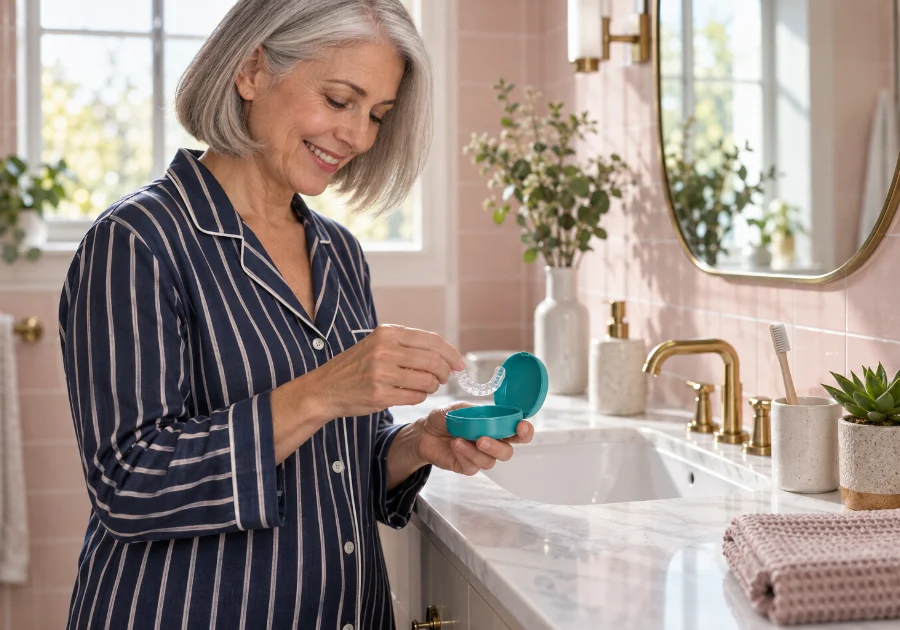
If your dentist has seen wear on your teeth, you may have been offered a night guard. The NHS1 describes the goal plainly: a mouth guard or splint, worn at night, protects your teeth from damage. What the trials show is narrower than many people assume.
What the reviews found
| Review | What it found |
|---|---|
| Cochrane review, 2007 (5 trials) | “There is not sufficient evidence” that a guard treats sleep grinding itself; it may help with tooth wear2 |
| UK Health Technology Assessment3, 2020 (52 trials of splints for jaw disorders or grinding) | No trial measured tooth wear in people who grind, so there isn’t enough evidence to say whether guards prevent it. For jaw joint disorders, splints didn’t reduce pain compared with no splint. The evidence was very low quality3 |
| Botox review, 2023 (10 studies) | Injections into the jaw muscles reduced bite force and pain. The effect started within 4 weeks, peaked at 5 to 8 weeks and lasted up to 24 weeks. Guards held up longer after 9 to 12 weeks4 |
So a guard is a shield more than a cure. Protecting teeth is the job the NHS1 gives it. The reviews just haven’t shown that it stops the jaw from working at night.23
Ask what yours is for
- Protection, jaw pain, or breathing? A guard to protect teeth, a splint for jaw pain and a device that moves the jaw forward for snoring or sleep apnea are different tools with different goals. See follow-up checks for a sleep apnea mouthpiece.
- How will you know it’s working? Ask what your dentist will check at the next visit.
- Thinking about Botox? The 2023 review called it effective for bite force and pain but said its effects after 24 weeks and with repeat injections still need study.4
Check your medicine list
A review of published case reports found grinding linked to antidepressants, most often in women. Fluoxetine, sertraline and venlafaxine came up most. Symptoms could start within 3 to 4 weeks of starting the medicine and ease within 3 to 4 weeks of stopping it, switching, or adding buspirone.5 How often this happens is unknown.5 If your grinding started after a new prescription, tell the prescriber; don’t stop it on your own.
When to book
The NHS1 says to see a dentist if you grind and have damaged or sensitive teeth, pain in your jaw, face or ear, or a partner who hears you grinding.1 A GP can help with causes such as stress, anxiety, smoking or drinking.1 Read more about why you grind your teeth at night and waking up with a headache.
Try: “You’ve suggested a night guard. Is it to protect my teeth or to treat the grinding, what should I expect it to change, and could my sertraline be playing a part?”
Did I Do That in My Sleep? covers this in Chapter 6, “The Jaw That Worked All Night.” Its Jaw Page keeps a short record of waking pain, tooth sensitivity, reports of grinding and recent medicine changes, plus what the guard helps or causes. See the book.
This article is for general educational purposes only and is not medical advice. It isn't a substitute for diagnosis or treatment from a qualified healthcare professional who knows your health history. Don't stop or change an antidepressant without your prescriber. See a dentist for cracked or sensitive teeth or jaw pain, and get urgent care if your jaw locks and you can't open or close your mouth. Girl Playbook does not endorse any specific product, test, or provider.
Girl Playbook sells this book. It provides education and worksheets, not individualized medical care.
Sources
The research behind this article, in the order it’s cited. How we source our articles.
- NHS, 2026Teeth grinding (bruxism) (opens in a new tab)abcde
- Cochrane Database of Systematic Reviews (abstract via PubMed), 2007Occlusal splints for treating sleep bruxism (tooth grinding) (opens in a new tab)ab
- Health Technology Assessment (via PubMed Central), 2020Oral splints for patients with temporomandibular disorders or bruxism: a systematic review and economic evaluation (opens in a new tab)abc
- Aesthetic Plastic Surgery (abstract via PubMed), 2023Effectiveness of Botulinum Toxin Injection on Bruxism: A Systematic Review and Meta-analysis of Randomized Controlled Trials (opens in a new tab)ab
- Neurology: Clinical Practice (abstract via PubMed), 2018SSRI-associated bruxism: A systematic review of published case reports (opens in a new tab)ab
Spotted something out of date? Tell us and we’ll check it.


