Does a Sleep Eye Mask Help?What Studies Found
Sleep & NighttimeArticleStreetlights, early sunrise and a partner's reading lamp can all reach your eyes at night. In a UK study, young adults who wore an eye mask for a week did better on memory and alertness tests than in a week without one. In hospital intensive care units, reviews found eye masks and earplugs improved sleep. Here is what the research shows, who it fits, and what to try.
In this article
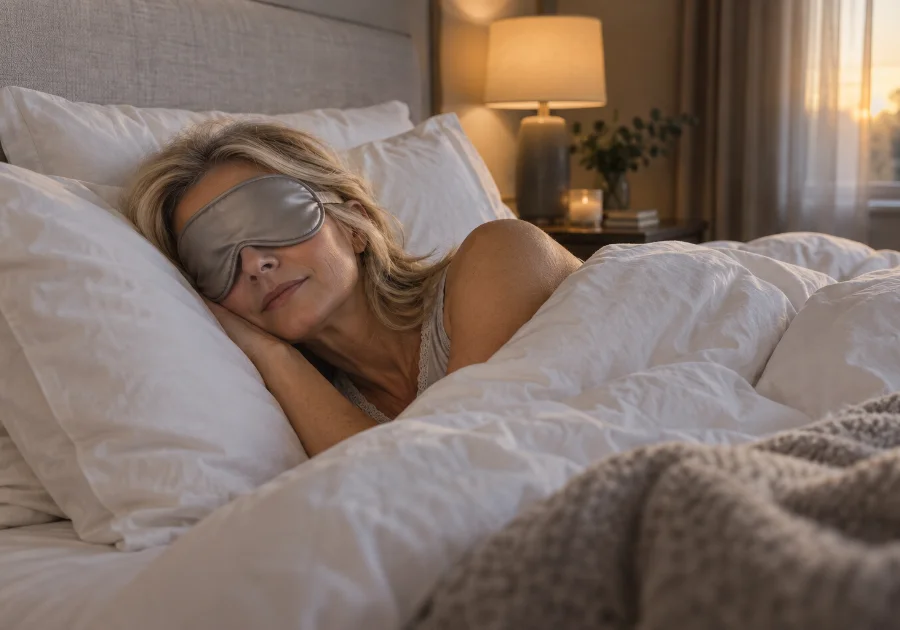
Light at night is everywhere: streetlights through the curtains, an early summer sunrise, a partner who reads late. An eye mask is a cheap way to block it. Here is what studies have tested.
The week-long mask study
Researchers at Cardiff University had 94 adults aged 18 to 35 sleep with an eye mask every night for a week, and another week when light wasn’t blocked.1
- After the mask week, they did better on a memory test for learning new information and showed better alertness.1
- In a second group of 35, a sleep tracker showed the memory benefit went with more deep (slow-wave) sleep.1
These were young adults, the effects were measured on tests rather than in daily life, and it’s one research group. Whether it holds for women over 50 hasn’t been tested.
In hospital
Hospital wards are bright and noisy at night, so eye masks have been tested in intensive care:
| Review | Finding |
|---|---|
| Cochrane, 30 trials | Earplugs, eye masks or both may add sleep time, about 2 hours in a pooled analysis of two small trials; low-quality evidence2 |
| 2024 review, 24 trials, 1,507 patients | Eye masks had the biggest effect of the sound and light measures tested; earplugs plus eye mask plus music was the best combination3 |
If you or someone you’re caring for is going into hospital, packing a mask and earplugs is a reasonable idea. See hospital sleep interruptions.
Who might benefit
- You wake with early light or sleep in a room you can’t fully darken.
- A partner reads or uses a phone after you’re asleep.
- You sleep during the day after night shifts.
Sleeping with a light on has been linked with health risks in older adults; see sleeping with the light on. For noise, see white noise and earplugs.
Tips
- Choose a soft, contoured mask that doesn’t press on your eyes.
- Give it a week. In the study, the first five nights were for getting used to it.1
- Keep a small light by the bed for getting up at night safely.
Try: “My partner reads late and the light wakes me. I’ve started using an eye mask. Is there anything else you’d suggest before we consider other sleep treatments?”
Did I Do That in My Sleep? covers light in Chapter 10, “In Bed All Night, Tired All Day,” in a section called “Light, Screens and a Usable Routine.” It focuses on what light actually does in your evening and night, rather than a one-size rule. See the book.
This article is for general educational purposes only and is not medical advice. It isn't a substitute for diagnosis or treatment from a qualified healthcare professional who knows your health history. Don't wear an eye mask if it irritates your eyes or skin, and keep a light handy for getting up at night to avoid falls. See a clinician for ongoing trouble sleeping, loud snoring with pauses, or heavy daytime sleepiness. Girl Playbook does not endorse any specific product, test, or provider.
Girl Playbook sells this book. It provides education and worksheets, not individualized medical care.
Sources
The research behind this article, in the order it’s cited. How we source our articles.
- Sleep journal (via PubMed Central), 2023Wearing an eye mask during overnight sleep improves episodic learning and alertness (opens in a new tab)abcd
- Cochrane Database of Systematic Reviews (abstract via PubMed), 2015Non-pharmacological interventions for sleep promotion in the intensive care unit (opens in a new tab)↩
- Nursing in Critical Care (abstract via PubMed), 2024Effectiveness of sound and darkness interventions for critically ill patients' sleep quality: A systematic review and component network meta-analysis (opens in a new tab)↩
Spotted something out of date? Tell us and we’ll check it.