Heavy Lifting for Bones After Menopause?What the LIFTMOR Trial Found
Menopause & HormonesArticleWomen with low bone density are often told to stick to light weights. In the LIFTMOR trial, supervised high-intensity lifting and jumping twice a week for 8 months improved spine and hip bone density, posture height and strength in postmenopausal women, with only one minor back spasm reported. Supervision was key.
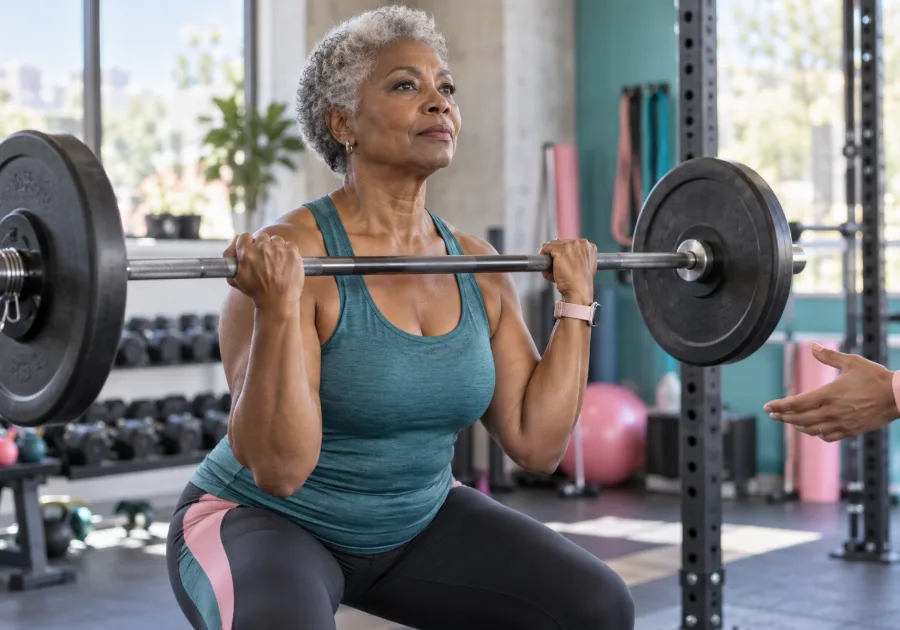
Bone loss speeds up after menopause, and many women with low bone density are steered toward gentle exercise for fear of fractures.1 The LIFTMOR trial tested a very different approach.
The study
Researchers randomly assigned 101 postmenopausal women, average age 65, with low bone mass (osteopenia or osteoporosis) to one of two programs for 8 months:1
- Supervised high-intensity training: 30 minutes twice a week of heavy resistance exercise, done as 5 sets of 5 at more than 85% of each woman’s maximum, plus impact training
- Home-based low-intensity exercise for comparison
Women were screened for conditions and medicines that affect bone and physical function.1
What happened
| Measure | High-intensity group | Home exercise group |
|---|---|---|
| Spine bone density | +2.9% | -1.2%1 |
| Hip (femoral neck) bone density | +0.3% | -1.9%1 |
| Height | Small gain | Small loss1 |
| Strength and balance tests | Improved more on every measure1 |
Only one adverse event was reported: a minor lower back spasm.1 Women attended about 92% of sessions.1
The important caveats
- Supervision was close and expert. The authors stressed the program was safe “under highly supervised conditions.”1
- Participants were otherwise healthy. Results may differ with past spine fractures or other conditions.
- Bone density is not the same as fracture prevention. The trial wasn’t large enough to measure fractures.
Where it fits
A 2026 clinical review encourages combining resistance, impact and balance exercise with medicine when needed, chosen through shared decision-making.2 Exercise and medicine aren’t either-or. Our guides to T-scores and Z-scores, weighted vests, alendronate versus zoledronate and FRAX risk cover related decisions.
Questions to ask
- Is heavy, supervised lifting safe for me, given my scans and any past fractures?
- Can you refer me to a trainer or physical therapist experienced with osteoporosis?
- Should I take bone medicine as well?
Try: “My T-score is -2.6 and I’d like to start lifting. Can you clear me and recommend someone who supervises osteoporosis strength programs?”
My Body Changed. Now What? includes a Visit Brief. Use it to note your bone density results, fractures and exercise goals. See the book.
This article is for general educational purposes only and is not medical advice. It isn't a substitute for diagnosis or treatment from a qualified healthcare professional who knows your health history. Please don't start high-intensity lifting with osteoporosis or a past fracture without medical clearance and qualified supervision. Exercise doesn't replace prescribed bone medicine unless your clinician says so. Sudden back pain, especially after lifting, should be evaluated. If you think you may be having a medical emergency, call 911 or your local emergency number right away. This article discusses published research. Girl Playbook does not endorse any specific product, test, or provider.
Girl Playbook sells this book. It provides education and worksheets, not individualized medical care.
Sources
The research behind this article, in the order it’s cited. How we source our articles.
- Journal of Bone and Mineral Research (abstract via Europe PMC), 2018High-Intensity Resistance and Impact Training Improves Bone Mineral Density and Physical Function in Postmenopausal Women With Osteopenia and Osteoporosis: The LIFTMOR Randomized Controlled Trial (opens in a new tab)abcdefghij
- Journal of Clinical Endocrinology and Metabolism (full text via PubMed Central), 2026Approach to personalizing the treatment of osteoporosis (opens in a new tab)↩
Spotted something out of date? Tell us and we’ll check it.


