Losing Height After 50: How Much Matters and When to Ask About Your Spine
Menopause & HormonesArticleA little shrinking with age is common, but height loss can also be the only sign of spine fractures that never hurt. US bone guidelines set clear lines: 1.5 inches from your young-adult height, or 0.8 inches since your last measurement. Here is what those numbers mean and what to ask for.
In this article
Plenty of women notice they’ve shrunk a little by their 60s. Sometimes that’s ordinary. Sometimes it’s the only sign of a spine fracture that never hurt. The Bone Health and Osteoporosis Foundation (BHOF)1 warns that most vertebral (spine) fractures cause no symptoms and “may go undiagnosed for many years.”
The two numbers that matter
| How you measure it | The line in US bone guidelines |
|---|---|
| Compared with your peak height as a young adult | 1.5 inches (about 4 cm) or more1 |
| Compared with your last measured height | 0.8 inches (about 2 cm) or more1 |
For women past menopause, either one is a reason to consider a bone density test and an X-ray or scan of the spine to look for hidden fractures.1 If you’re already being followed for bone loss, the same losses are a reason to repeat spine imaging.1
Measure it properly
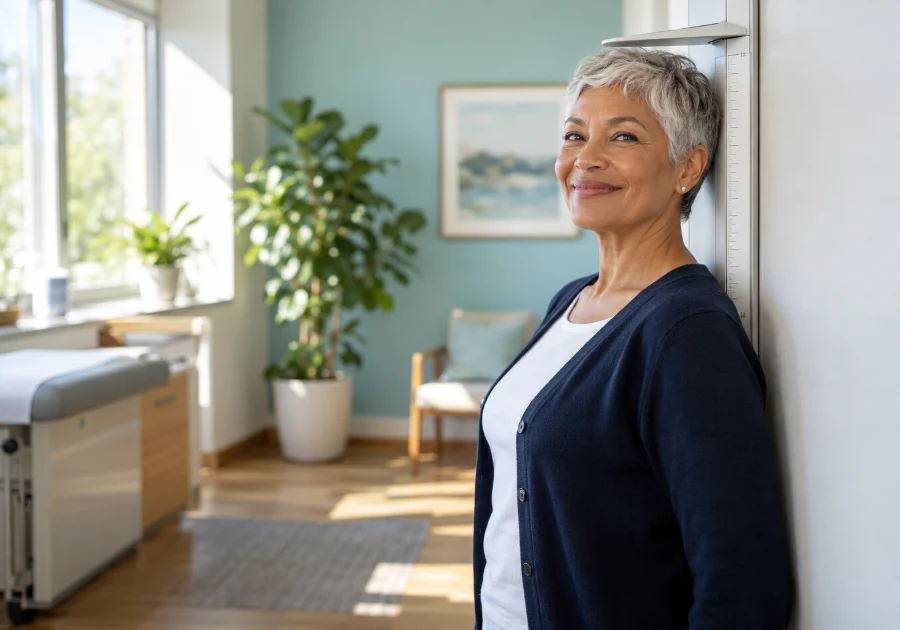
- Once a year, shoes off, against a wall-mounted measure. The BHOF says wall-mounted measures are more reliable than freestanding ones.1
- Know your starting point. Your height on an old driver’s license or from your 20s gives your clinician a peak to compare against.
Height loss carries its own risk
In a US study of 3,124 women aged 65 and older, height was measured about 15 years apart. Women who lost more than 2 inches (5 cm) had about a 50% higher risk of hip fracture, other fractures and death, even after accounting for spine fractures and bone density.2 It’s an observational study, so it shows a link, not a cause.2
Other clues to mention
- A new stoop, or back pain with no clear cause, are reasons to look for new spine fractures.1
- Several spine fractures can do more than bend your posture. Fractures in the upper back can restrict breathing, and fractures in the lower back can cause constipation, belly pain, early fullness and weight loss.1
- Any broken bone after 50, whatever the cause, should be checked for osteoporosis.1
What helps
- Get the right tests. See T-score vs Z-score, the FRAX bone health checklist and bone density scan coverage.
- Strength training can be safe and helpful. In the LIFTMOR trial, supervised high-intensity training in women around 65 with low bone density reduced the stoop without raising spine fracture risk.1 See the LIFTMOR trial.
Try: “I used to be 5 foot 6, and today I measured 5 foot 4 and a half. Should I have a bone density test, and should we image my spine to look for fractures?”
My Body Changed. Now What? lists height loss or a new stoop as a reason to ask about bone health, alongside a fracture after a minor fall. Add your young-adult height and today’s height to your Visit Brief, with any family history of hip fracture. See the book.
This article is for general educational purposes only and is not medical advice. It isn't a substitute for diagnosis or treatment from a qualified healthcare professional who knows your health history. Sudden severe back pain, especially after a minor fall, lift or cough, needs prompt medical assessment, and back pain with numbness, weakness or loss of bladder or bowel control needs emergency care. Girl Playbook does not endorse any specific product, test, or provider.
Girl Playbook sells this book. It provides education and worksheets, not individualized medical care.
Sources
The research behind this article, in the order it’s cited. How we source our articles.
- Bone Health and Osteoporosis Foundation (Osteoporosis International, via PubMed Central), 2022The clinician's guide to prevention and treatment of osteoporosis (opens in a new tab)abcdefghijk
- Journal of Bone and Mineral Research (via PubMed Central), 2012Height loss in older women: risk of hip fracture and mortality independent of vertebral fractures (opens in a new tab)ab
Spotted something out of date? Tell us and we’ll check it.


