Does Reading on a Tablet Before Bed Hurt Your Sleep?
Sleep & NighttimeArticleIn a Harvard sleep-lab study, people who read on an iPad for four hours before bed took about 10 minutes longer to fall asleep, made half as much melatonin and felt groggier the next morning than when they read a printed book. A later trial found the iPhone's Night Shift setting didn't improve sleep. Here is what these studies can and can't tell you about your own bedtime screen.
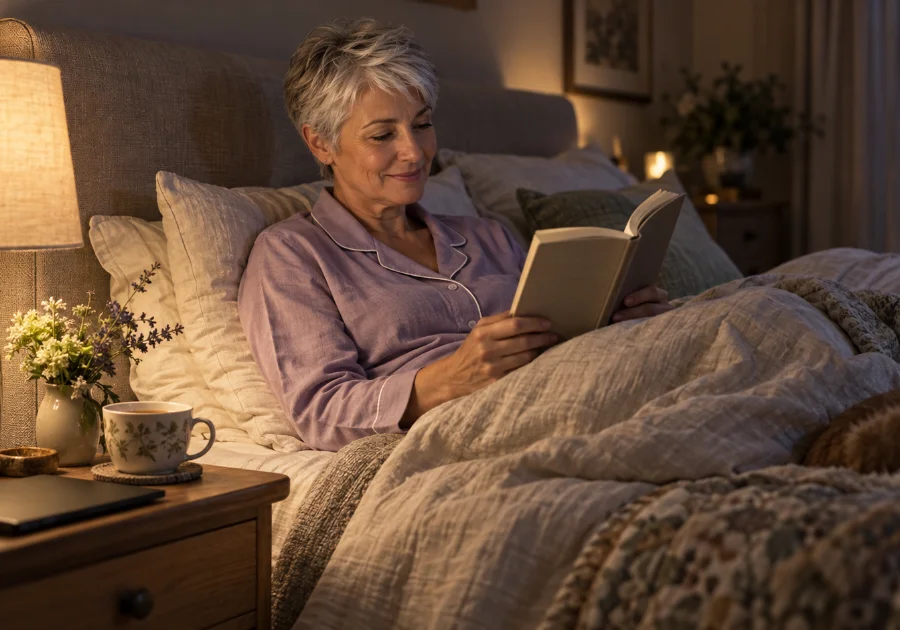
A tablet makes bedtime reading easy, and many women wonder whether the screen is costing them sleep. Two studies tested it directly.
The iPad versus print study
At Brigham and Women’s Hospital in Boston, 12 healthy young adults lived in a sleep lab for two weeks.1 For five evenings they read on an iPad for about four hours before bed in dim light; for five others they read a printed book.1
| After reading on the iPad | Compared with the printed book |
|---|---|
| Time to fall asleep | About 10 minutes longer1 |
| Evening melatonin | Cut by about 55%1 |
| Body clock | Melatonin rose more than 1.5 hours later the next evening1 |
| Dream (REM) sleep | Less1 |
| Next morning | Sleepier, and slower to feel fully awake1 |
The limits: 12 people averaging 25 years old, reading for four hours in very dim rooms, which is more screen light and less room light than most homes.1
Does Night Shift fix it?
A 2021 trial randomly assigned 167 university students to use an iPhone for an hour before bed with Night Shift on, with it off, or not at all, for a week.2 Sleep was tracked with wrist monitors.2
- No significant differences in sleep between the three groups.2
- Among students who slept more than 6.8 hours a night, those who skipped the phone slept best.2
So the color filter didn’t help, and putting the phone away might.2 Both studies were in young adults, and neither tested women over 50.
What this means for your bedtime
- The dose matters. Four hours of screen in a dark room is a big dose; 20 minutes in a lit room is a much smaller one, and wasn’t tested.
- Paper is the safe choice if you’re already struggling to fall asleep.1
- Dimming or warm filters don’t replace putting the device down.2 See blue-light glasses for sleep.
- Test it on yourself: a week of paper, a week of tablet, and compare how long it took to fall asleep.
If sleep has been hard for months, see why you can’t fall asleep and insomnia and CBT-I.
Try: “I read on my tablet for an hour in bed and it takes me 45 minutes to fall asleep. Is the screen likely part of it, or should we look at other causes?”
Did I Do That in My Sleep? covers this kind of one-change test in Chapter 4, “The Night Map,” as Notice It. Its 14-Night Lights-Out Record takes a minute each morning and has room for the one thing you’re testing, such as paper versus screen. See the book.
This article is for general educational purposes only and is not medical advice. It isn't a substitute for diagnosis or treatment from a qualified healthcare professional who knows your health history. Trouble sleeping three or more nights a week for three months or more, loud snoring with pauses in breathing, or daytime sleepiness that affects driving are reasons to see a clinician. Girl Playbook does not endorse any specific product, test, or provider.
Girl Playbook sells this book. It provides education and worksheets, not individualized medical care.
Sources
The research behind this article, in the order it’s cited. How we source our articles.
- Proceedings of the National Academy of Sciences (via PubMed Central), 2015Evening use of light-emitting eReaders negatively affects sleep, circadian timing, and next-morning alertness (opens in a new tab)abcdefghi
- Sleep Health (abstract via PubMed), 2021Does iPhone night shift mitigate negative effects of smartphone use on sleep outcomes in emerging adults? (opens in a new tab)abcdef
Spotted something out of date? Tell us and we’ll check it.


