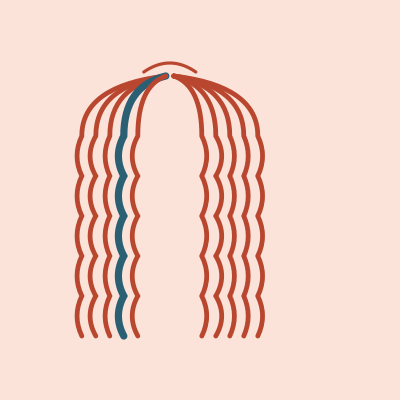
Straight hair
Let hair dry a little before gently using a wide-tooth comb.
Free shipping
Hair
Combing direction demonstratorExplore where to start each detangling pass and which direction to comb. Use an original visual guide to understand starting at the ends and gradually working higher.
A learning guide for ordinary tangles. The drawings show direction, not a force, speed or required number of strokes. Be gentle and do not force a comb through resistance.
Two different directions to understand
The illustration separates where a pass begins from where it finishes. These are three teaching positions, not three mandatory strokes.
Begin close to the ends
Work through the lower tangles first. This drawing shows the starting point low down and the pass continuing toward the ends.
Before you begin
Let hair dry a little before gently using a wide-tooth comb.
Detangle with hair damp or wet and appropriately conditioned. Work in sections; fingers or a suitable wide-tooth comb can help. Follow your conditioner’s instructions.
The section in this drawing is schematic. It does not identify your curl pattern or recommend a brand or hair treatment.
Keep the direction clear
01 · Ends
Work through the lower tangles first. This drawing shows the starting point low down and the pass continuing toward the ends.
02 · Middle
After the lower part is easier to comb, begin a later pass higher up. The direction is still toward the ends, through the length below that starting point.
03 · Higher up
Continue starting higher as the lower lengths become easier to comb. Moving the starting point upward is different from combing upward toward the scalp.
You can revisit a lower section rather than pull through a tangle. The illustrations do not simulate knots being removed or guarantee less breakage.
Make the most of this tool
Choose an illustrative starting point near the ends, in the middle or higher up. Switch between the start and finish of that pass. The arrow always points toward the ends; moving the starting point higher between passes is a separate action. Print the three-diagram reference if useful.
In this guide, it means starting later passes higher up once the lower lengths are easier to comb. Each illustrated pass travels toward the ends. The drawings teach this distinction without prescribing a speed, force or number of strokes.
Preparation differs. AAD guidance suggests letting straight hair dry a little before gentle wide-tooth combing, while curly or tightly coiled hair is detangled damp or wet with appropriate conditioning. Read the preparation notes and follow the directions for your products.
Research checked October 9, 2026. Original diagrams and explanations informed by the guidance below. Illustrative comb placement is not a measurement or a prescribed technique for severe matting, extensions or a scalp condition.