Staying Up Late Though You're Tired?Bedtime Procrastination Studies
Sleep & NighttimeArticleScrolling, one more episode, finally some time to yourself: many people go to bed later than they meant to for no outside reason. Researchers call it bedtime procrastination. In a representative Dutch survey of 2,431 adults, it was common and tied to not getting enough sleep. In a small trial, a behavioral program cut it by about 46 minutes a night. Here is what the research shows.
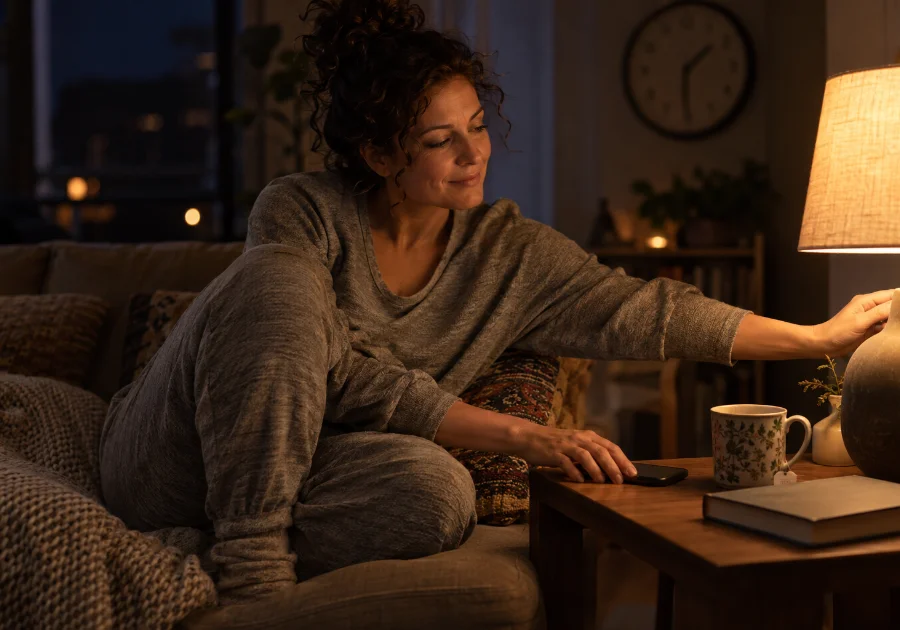
You’re exhausted, and still you’re up past midnight on your phone or finishing one more episode. If nothing is actually stopping you from going to bed, researchers have a name for it: bedtime procrastination, going to bed later than you meant to without an outside reason.1
How common it is
A survey of 2,431 Dutch adults, chosen to represent the population, found that a large share regularly went to bed later than they wanted to and didn’t get enough sleep.1 Bedtime procrastination helped explain the link between self-control and short sleep.1
What it’s linked with
A 2022 review of 43 studies found bedtime procrastination went with:2
| Linked with | Direction |
|---|---|
| Sleep duration | Shorter2 |
| Sleep quality | Worse2 |
| Daytime fatigue | More2 |
| Being a night owl | More likely2 |
| Self-control | Lower2 |
The studies were mostly snapshots of low quality, so they can’t show what causes what.2
Why people do it
In a small trial, researchers asked what staying up did for each person. The most common reasons were:3
- Managing emotions (31%), like winding down from a hard day
- Compensation (27%), claiming time for yourself after a day for others
- Social connection (18%), staying in touch with people
That fits a familiar pattern: the late hours can feel like the only time that’s yours.
Can it be changed?
60 young adults, most of them women, were randomly assigned to a behavioral program or a waitlist.3 Those in the program:
The trial was small, short and open-label, and the participants were in their early twenties.3
What to try
- Name what the late hours give you, whether it’s quiet, connection or recovery, and find a slot for it earlier in the evening.3
- Set a “start winding down” alarm, not just a bedtime.
- Charge your phone outside the bedroom.
- Ask whether your evenings have any room; if the day leaves no time for you, the fix may be in the day.
See also reading on a tablet before bed and catching up on sleep at weekends.
Try: “I go to bed late every night even though I’m exhausted, because it’s the only time I get to myself. Is there a way to fix this without giving that up?”
Did I Do That in My Sleep? covers this in Chapter 10, “In Bed All Night, Tired All Day,” in a section called “Opportunity Comes First,” which starts with how much time your life actually leaves for sleep. Its tired-day account records that sleep opportunity beside what the next day cost. See the book.
This article is for general educational purposes only and is not medical advice. It isn't a substitute for diagnosis or treatment from a qualified healthcare professional who knows your health history. See a doctor if you can't fall asleep even when you go to bed on time, if you're very sleepy during the day, or if low mood or anxiety is keeping you up. Don't drive when sleepy. Girl Playbook does not endorse any specific product, test, or provider.
Girl Playbook sells this book. It provides education and worksheets, not individualized medical care.
Sources
The research behind this article, in the order it’s cited. How we source our articles.
- Journal of Health Psychology (abstract via PubMed), 2016Bedtime procrastination: A self-regulation perspective on sleep insufficiency in the general population (opens in a new tab)abc
- Sleep Medicine Reviews (abstract via PubMed), 2022Go to bed! A systematic review and meta-analysis of bedtime procrastination correlates and sleep outcomes (opens in a new tab)abcdefg
- Sleep Medicine (abstract via PubMed), 2023A randomized controlled trial of a behavioral intervention for decreasing bedtime procrastination using a wait-list control group in a non-clinical sample of young adults (opens in a new tab)abcdef
Spotted something out of date? Tell us and we’ll check it.


