Best Bedroom Temperature for Sleep After 65: A Boston Study
Sleep & NighttimeArticleMost advice says to keep the bedroom cool, often with one number. A Boston study tracked 50 adults aged 65 and up in their own homes for nearly 11,000 nights and found they slept best between 20 and 25°C (68 to 77°F), with sleep efficiency dropping 5 to 10% as the room rose from 25 to 30°C. Here is what it measured and why your own best number may differ.
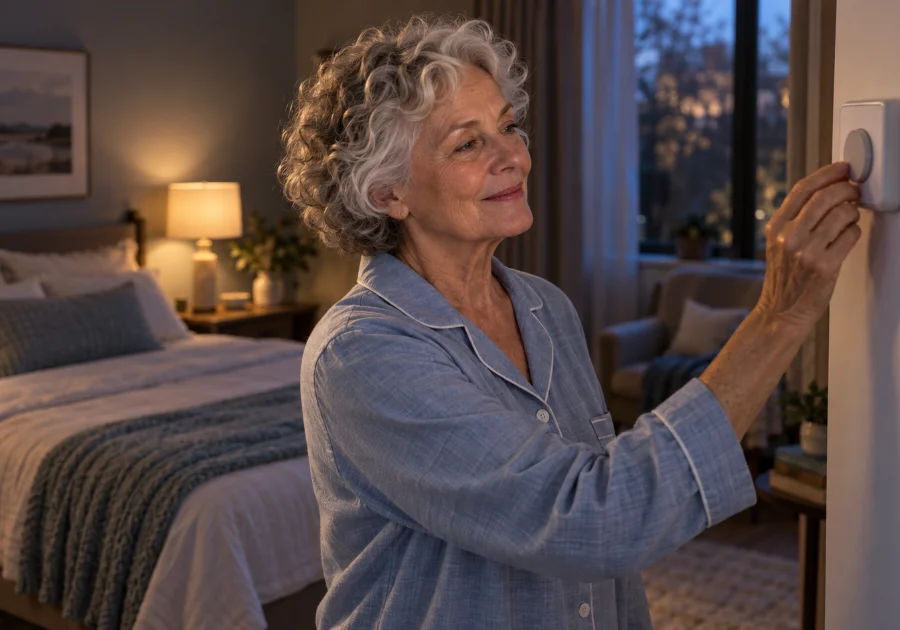
“Keep your bedroom cool” is standard sleep advice. A Boston team put sensors in older adults’ bedrooms to find out how cool, in people’s own homes instead of a sleep lab.
What the study did
- 50 adults aged 65 and up living in the Boston area.1
- Room sensors in the bedroom and living room, and a sleep-tracking ring on each person.1
- 10,903 nights of data, about 7 months per person on average.1
What it found
| Bedroom temperature at night | Sleep |
|---|---|
| 20 to 25°C (68 to 77°F) | Most efficient and most restful1 |
| 25 to 30°C (77 to 86°F) | Sleep efficiency dropped 5 to 10%, a change the authors called clinically relevant1 |
The link wasn’t a straight line, and people differed a lot.1 The authors stressed adjusting temperature to the person rather than chasing one number.1
The limits: one city, a fairly well-off group, and sleep measured by a consumer ring rather than a lab test.1
Heat versus cold
A review of lab studies found that under everyday conditions, with bedding and clothes, heat increases waking and cuts deep sleep and dream sleep, and humid heat adds to the load.2 Cold didn’t change sleep stages when people had enough bedding, but it did affect heart rhythm control during sleep, so the authors warned against assuming cold is harmless.2
So “cooler is better” holds up to a point. A bedroom that’s too cold, with thin covers, isn’t the goal.
Find your own number
- Put a cheap thermometer by the bed and note the reading at bedtime.
- Log for two weeks: the temperature, how long it took to fall asleep, how often you woke, how rested you felt.
- Shift one degree at a time and compare weeks.
If hot flashes or night sweats wake you, see cooling sheets and pads, why you sweat so much at night and a warm bath before bed.
Try: “I wake two or three times a night, and my bedroom is about 26°C in summer. Is temperature worth fixing first, or should we look at other causes?”
Did I Do That in My Sleep? covers the bedroom in Chapter 9, “The Three A.M. Wardrobe Change,” in sections called “Make the Bedroom Easier to Use” and “The Cooling Claim.” Its 14-Night Lights-Out Record takes a minute each morning and has room for the one thing you’re testing, such as the thermostat. See the book.
This article is for general educational purposes only and is not medical advice. It isn't a substitute for diagnosis or treatment from a qualified healthcare professional who knows your health history. In a heat wave, older adults are at higher risk of heat illness; confusion, a racing heart, fainting or a very high body temperature need urgent help. Drenching night sweats with fever or weight loss need a check. Girl Playbook does not endorse any specific product, test, or provider.
Girl Playbook sells this book. It provides education and worksheets, not individualized medical care.
Sources
The research behind this article, in the order it’s cited. How we source our articles.
- Science of the Total Environment (via PubMed Central), 2023Nighttime ambient temperature and sleep in community-dwelling older adults (opens in a new tab)abcdefgh
- Journal of Physiological Anthropology (via PubMed Central), 2012Effects of thermal environment on sleep and circadian rhythm (opens in a new tab)ab
Spotted something out of date? Tell us and we’ll check it.


