Hair Texture Changes After Menopause: What Studies Measured
HairArticleIf your ponytail feels thinner and your hair behaves differently than it did at 40, the measurements back you up. In a study of more than 1,400 women, strands grew thicker until about 40 to 45 and then got finer, while the number of hairs fell from the 20s on. Here is what changes, how common pattern thinning is after menopause, and which changes need a dermatologist.
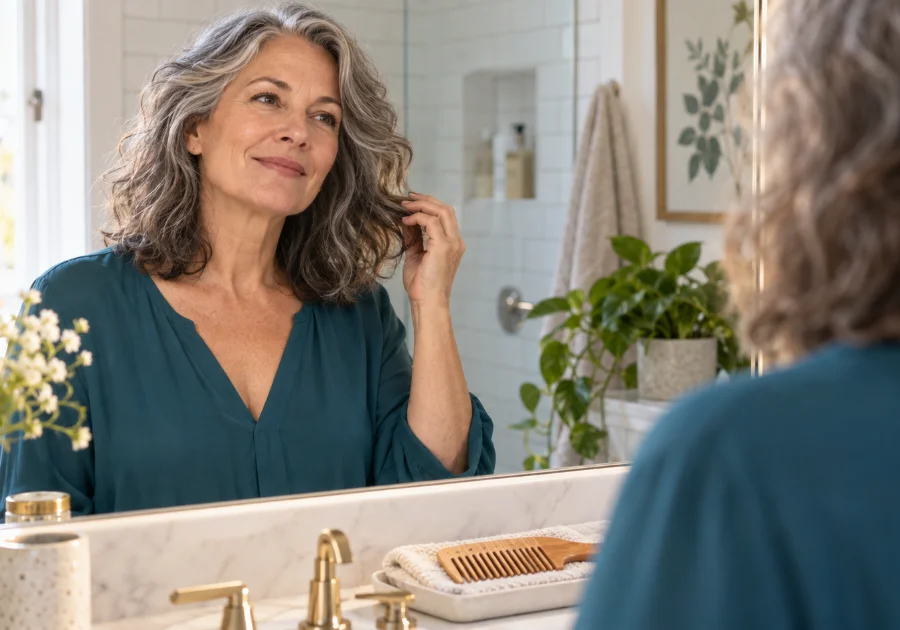
Plenty of women in their 50s say their hair “isn’t the same hair” anymore: a smaller ponytail, less body, ends that won’t behave. Researchers have measured some of this strand by strand.
What the measurements show
A 2012 study measured the scalp hair of 1,099 women aged 18 to 66 who felt their hair was thinning and 315 women aged 17 to 86 who didn’t.1 All were white women, so the numbers may differ for other hair types.1
| Measure | What happened with age |
|---|---|
| Thickness of each strand | Rose from age 20 to about 40 to 45, then fell1 |
| Number of hairs per square centimeter | Highest at 20 to 30, then fell, faster with each decade1 |
| What women noticed | Thicker strands hid the loss of hairs until the mid-30s; thinning became more noticeable from the mid-40s to the mid-to-late 50s1 |
So in your 40s and 50s you may lose on two counts at once: fewer hairs, and each one finer than before. In women who felt their hair was thinning, the number of hairs fell faster than in women who didn’t.1
Where menopause fits
A 2025 review says the hormone shifts of the menopause transition can change the hair shaft and the hair cycle, with lower density, thinner strands and changes in texture.2 A 2022 review notes that fewer hairs are in the growing (anagen) phase after menopause.3 Another 2022 review lists “altered hair quality and structure” among menopause hair symptoms, along with more unwanted facial hair.4 One of its authors worked for a skin-care company.4
How common is pattern thinning? In a Thai study of 178 women aged 50 to 65 who were past menopause, 52.2% had some female-pattern thinning, and 73.2% of those cases were the mildest grade.5 After adjusting for age and family history, the only factor linked to it was a body mass index of 25 or higher.5 That’s one clinic and one snapshot in time.
Which changes need a dermatologist
Finer, softer hair that came on over years is common. Two hair conditions show up more often after menopause and are worth a visit:23
- Female pattern hair loss: a widening part and thinning on top. See a widening part after 50.
- Frontal fibrosing alopecia: a hairline moving back at the front or sides, often with thinning eyebrows. This one scars, so the visit shouldn’t wait. See four things to notice.
Heavy shedding that starts suddenly is a different pattern, usually a response to something that happened about three months earlier. See why your hair is shedding so much.
Hormone therapy: the 2022 menopause review says it isn’t indicated for skin and hair symptoms alone.4 Hair can be part of a wider conversation about menopause treatment.
For dryness and snapping, see why hair gets dry and brittle and breakage versus shedding.
Try: “My hair has gotten finer since menopause and my ponytail is about half as thick. Is this pattern thinning, and is it worth starting treatment now?”
Hair, Everywhere covers this in Chapter 10, “Less Here, More There,” in its “After Menopause” section. Its Hair Log pairs a monthly photo of your part with one of your hairline and brows, so a slow change and a fast one look different on paper. See the book.
This article is for general educational purposes only and is not medical advice. It isn't a substitute for diagnosis or treatment from a qualified healthcare professional who knows your health history. See a dermatologist promptly for hair loss with scalp pain, burning or itching, smooth shiny patches, a hairline moving back at the front or sides, round bald patches, or fast loss with no clear trigger. Girl Playbook does not endorse any specific product, test, or provider.
Girl Playbook sells this book. It provides education and worksheets, not individualized medical care.
Sources
The research behind this article, in the order it’s cited. How we source our articles.
- British Journal of Dermatology (abstract via PubMed), 2012What women want: quantifying the perception of hair amount. An analysis of hair diameter and density changes with age in caucasian women (opens in a new tab)abcdef
- Maturitas (abstract via PubMed), 2025Menopause and hair loss in women: Exploring the hormonal transition (opens in a new tab)ab
- Clinical and Experimental Dermatology (via PubMed Central), 2022Menopause, skin and common dermatoses. Part 1: hair disorders (opens in a new tab)ab
- Climacteric (abstract via PubMed), 2022Skin, hair and beyond: the impact of menopause (opens in a new tab)abc
- The North American Menopause Society, now The Menopause Society (journal Menopause, abstract via PubMed), 2022Prevalence of female pattern hair loss in postmenopausal women: a cross-sectional study (opens in a new tab)ab
Spotted something out of date? Tell us and we’ll check it.


